Pick the Best Plan for You
Choose the barcode plan that matches your download, volume, and integration needs.
FREE
$0
Forever Free


STARTER
/ month
 You save / year
Billed Yearly
BUSINESS
/ month
You save / yearBilled Yearly
Plans Benefits
You save up to % on Yearly Plan
Best for
Barcodes Per Month
1D Barcodes
2D Barcodes
Supported Barcode Types
Download Raster
Download Vector
Bulk Creation
API Access
Advertising
Mobile App
FREE
$0
Forever Free
Individual barcodes and small tasks
300
35+
PNG, JPG, JPEG
SVG
All QR Codes with Ads
STARTER
/ month
You save / yearBilled Yearly
Regular bulk creation
10,000
35+
PNG, JPG, JPEG
SVG, PDF
Up to 1,000 rows / batch
All QR Codes Ads-free
BUSINESS
/ month
You save / yearBilled Yearly
High-volume generation
100,000
35+
PNG, JPG, JPEG
SVG, PDF, EPS, AI
Up to 10,000 rows / batch
All QR Codes Ads-free

Need more than 100,000 barcodes a month?
Contact us to discuss your volume and integration needs.
Linear Barcode Generators
A linear barcode stores data in a single row of bars and spaces, and it is still the most widely scanned code in the world, from grocery checkouts to warehouse docks and post offices. This catalog brings together every linear barcode generator on ME-QR, so you can pick the exact format your retailer, carrier, or industry requires.
Each 1D barcode generator here checks your input against the rules of its symbology, calculates the check digit where one is needed, and produces a code that reads on ordinary laser and CCD scanners. Choose a format, enter your data, and download a print-ready file in seconds.
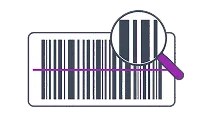
What Is a 1D Barcode?
In a one-dimensional (1D) barcode, data is expressed through the widths of parallel bars and the gaps between them. A scanner reads it along a single horizontal line, so the height of the bars has no effect on the data: taller bars only make the code easier to hit with a scanner beam. If someone asks what is a 1D barcode, this one-line scan is the key idea, and it is why these codes are also called linear.
Most 1D codes hold anywhere from a few digits to several dozen characters. Such capacity easily fits a product number, a serial number, or a tracking ID that points to a full record in a database.
Whatever the symbology, a 1D linear barcode consists of five elements:
Quiet zones: blank margins on the left and right that tell the scanner where the code begins and ends.
Start and stop patterns: fixed bar sequences that identify the symbology and the reading direction.
Data characters: the encoded number or text.
Check digit: a calculated character that helps the scanner catch misreads. It is mandatory in UPC, EAN, and Code 128 and optional in Code 39.
Human-readable text: the same data printed under the bars so people can type it in by hand.
Types of 1D Barcodes Available
Linear barcode symbologies vary by character set, maximum data length, and the industries that rely on them. The table groups the 1D barcode types in our catalog by family.
| Family | Barcodes | Data they encode | Typical uses |
|---|---|---|---|
| Retail | UPC-A, UPC-E, EAN-13, EAN-8 | Fixed-length numeric product numbers (GTINs) | Checkouts in stores and on marketplaces |
| Publishing | ISBN 13, ISBN 13 + 5 Digits, ISSN, ISMN | Numeric identifiers encoded as EAN-13 | Books, magazines, sheet music |
| General-purpose | Code 128, Code 39, Code 39 Full ASCII, Code 93, Code 11, MSI, Telepen Alpha | Variable-length numbers, letters, and symbols | Inventory, asset tags, ID badges, libraries |
| GS1 logistics | GS1-128 (UCC/EAN-128), EAN-14, Interleaved 2 of 5, GS1 DataBar, DataBar Limited, DataBar Expanded | GTINs plus Application Identifiers such as batch, weight, and dates | Cartons, pallets, fresh food, coupons |
| Healthcare | PZN8, Code 32 | National drug identification numbers | Pharmacies in Germany and Italy |
| Postal and print | DPD Barcode, UPU S10, Flattermarken | Parcel IDs, tracking numbers, sheet sequence marks | Parcel delivery, international mail, print finishing |
Retail Barcodes: UPC and EAN
UPC-A carries a 12-digit number and is the standard at checkouts in the US and Canada. Its compact sibling, UPC-E, suppresses zeros to shrink eligible UPC-A numbers to 8 digits for small packaging. EAN-13 is the 13-digit international equivalent, and EAN-8 serves products too small for a full EAN-13.
Publishing Barcodes: ISBN, ISSN, and ISMN
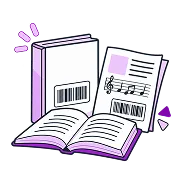
Books use ISBN 13, often with a 5-digit add-on that encodes the suggested retail price. Magazines and journals carry an ISSN inside an EAN-13 that starts with 977, and printed music uses ISMN with the 979-0 prefix.
General-Purpose Barcodes: Code 128, Code 39, and More
Code 128 encodes all 128 ASCII characters in a compact symbol, which makes it the default for shipping and inventory labels. Code 39 accepts uppercase letters, digits, and a few symbols and remains common in automotive and government applications. Its Full ASCII version adds lowercase letters and the remaining symbols. Code 93 is a denser alternative to Code 39, Code 11 labels telecom equipment, MSI marks retail shelves and warehouse bins, and Telepen Alpha is a long-time favorite of UK libraries.
GS1 Logistics Barcodes
Built on Code 128, GS1-128 uses Application Identifiers that let a single label hold a GTIN, a batch number, an expiry date, or an SSCC pallet code. EAN-14 identifies outer cartons, Interleaved 2 of 5 prints reliably on corrugated board, and the GS1 DataBar family fits product IDs and extra data such as weight onto small fresh-food labels and coupons.
Healthcare and Postal Barcodes
PZN8 identifies medicines sold in German pharmacies, and Code 32 does the same in Italy. For shipping, the DPD Barcode creates parcel labels for the DPD network, and UPU S10 produces the 13-character tracking IDs used for international registered mail and EMS. Flattermarken are step-shaped marks printed on the spine of folded sheets so bindery equipment can verify page order.
Looking for a specific barcode? 1D generator pages for each format let you set the options unique to that symbology.
How to Use the 1D Barcode Generator Online
Open the right generator. Select your symbology from the list above.
Enter the data. The tool checks the length and allowed characters as you type, so a 12-digit EAN-13 or an odd number of digits for Interleaved 2 of 5 is caught before you download.
Adjust the design. Set the size, colors, and font, and choose whether to show the human-readable line under the bars.
Save your file. Download PNG, JPG, or SVG, or switch to PDF and EPS on paid plans.
Need hundreds of codes at once? Paid plans let you upload a CSV or Excel file and create the whole batch in one go.
1D vs. 2D: When Linear Barcodes Are the Right Choice
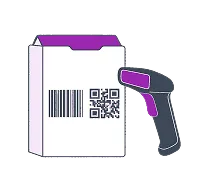
Linear barcodes hold far less data than QR codes or Data Matrix, yet they remain the practical choice in many situations. Nearly every installed scanner reads 1D barcodes, including older laser models that cannot decode 2D codes at all. They print cleanly on low-cost thermal printers, and formats such as UPC, EAN, and GS1-128 are written directly into the requirements of retailers and carriers.
A 2D barcode makes more sense when you need to store a URL, long text, or multiple data fields in a compact area, or when the code must stay readable despite scratches and partial damage. Retail is gradually moving toward 2D at the point of sale under the GS1 US Sunrise 2027 initiative, but 1D codes will stay on packaging alongside 2D ones for years. Most brands will simply print both, and you can make either type in the ME-QR catalog.
Why Create Linear Barcodes with ME-QR

Validation and Check Digits Built In
Instead of a separate tool for every standard, you get one barcode generator. 1D formats from retail to postal share the same interface, and each one knows its own rules: allowed characters, required length, and the check digit formula. Errors are flagged before the file is saved, not at the scanner.

Print-Ready Output
SVG files keep bars sharp at any size, which matters for 1D codes because blurred edges change bar widths and cause misreads. On the Business plan you can also edit quiet zones and match the resolution to 203 or 300 DPI thermal label printers.

Free to Start
The free plan covers up to 300 codes per month with no registration. Paid plans add bulk creation from spreadsheets, automatic sequential numbering, and API access for teams that generate codes at scale.
Create Your Linear Barcode Now
Pick a format, enter your data, and get a scannable 1D barcode in under a minute. Every symbology in this catalog is free to try with ME-QR.